
EQC & NZ Building Code Standards
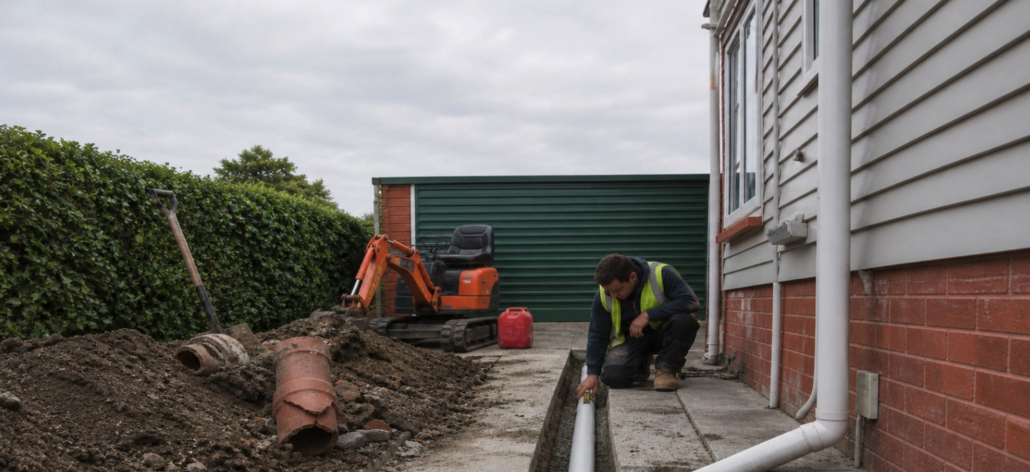
Christchurch homeowners are all too familiar with the complexities of earthquake repairs and, for many, the frustration of re-repairs.
When it comes to drainage, navigating the EQC (now the Natural Hazards Commission – NHC) process and ensuring compliance with the New Zealand Building Code can be a minefield.
More than a decade on, the legacy of the 2010–2011 Canterbury earthquake sequence continues to surface in the form of cracked drains, shifting foundations, and unexpected groundwater issues.
The Hidden Legacy Beneath Our Feet
One of the most insidious post-earthquake problems is damage that doesn’t reveal itself for years. The NHC itself acknowledges that earthquake damage to drains can take several years to become obvious.
This creates a ticking clock for homeowners who may have thought their property was fully repaired.
Wastewater lateral damage is a prime example. The Christchurch City Council notes that approximately 70% of blockages in wastewater laterals are found in the private section – the pipe from the household gully trap to the property boundary .
Many of these pipes were damaged in the earthquake sequence, but the symptoms only emerge later as sand, silt, and excess groundwater enter cracked pipes, causing blockages and overflows .
Consider the case of a Riccarton landlord who booked a routine CCTV drain inspection for a well-maintained rental property, expecting nothing more than peace of mind.
Beneath the neat garden and solid pathways, the camera revealed a different story – multiple cracks and offsets in the ceramic drain lines, likely caused by the 2010 – 2011 earthquakes.
The damage wasn’t causing major symptoms yet, but it was only a matter of time before a costly blockage or overflow occurred.
Thankfully, the property still had an EQC claim on record, and our team guided the owner through the successful repair claim process .
Land Drainage Issues: A Post-Quake Reality
The earthquakes fundamentally altered Christchurch’s groundwater dynamics. New groundwater springs have appeared on properties, localised settlement has created ponding after rainfall, and disused wells have been damaged – all causing drainage problems that didn’t exist before 2010.
The Christchurch City Council has produced specific guidance on land drainage repairs resulting from the earthquakes, confirming that these issues are the property owner’s responsibility to resolve. In many cases, where EQC identified land damage during assessment, homeowners may have received a settlement to cover part or all of the repair.
Repairing these issues often requires sophisticated solutions—installing new drainage systems discharging to Council-approved connections, or in cases where gravity systems aren’t viable, installing pump systems.
In the Port Hills area, any earthworks associated with land drainage installation are likely to require resource consent due to excavation depth, adding another layer of compliance complexity .
The Botched Repairs Crisis
Perhaps the most troubling chapter in Christchurch’s earthquake story is the widespread problem of substandard repairs. Under immense pressure to act swiftly, the EQC relied heavily on subcontractors – many of whom were stretched thin or lacked the experience to meet the unique challenges of earthquake-damaged properties .
Common issues reported include cracked or uneven foundations improperly repaired, substandard materials used in structural repairs, persistent leaks or poor drainage exacerbated by shoddy workmanship, and cosmetic fixes that masked underlying structural damage rather than addressing root causes.
Over a decade later, many Christchurch homeowners are still grappling with the fallout. The Government’s “On-sold Programme” was established to allow homeowners to reopen claims for botched repairs in houses they purchased, but recent rule changes have created new barriers, with arbitrary time limits and caps on repair costs that critics argue will leave homes improperly repaired.
Why a Certified Master Drainlayer Is Non-Negotiable
Drainage systems must comply with strict performance criteria outlined in the New Zealand Building Code, covering durability, surface water, and external moisture. For EQC/NHC-related repairs, the work must satisfy both the insurer and the Council.
Building consent is typically required for installation of drainage systems to discharge excess water and your engineer or contractor must assist with this. Depending on your location, resource consent from Environment Canterbury may also be required .
This is why it’s absolutely essential to use a CCC Approved, Certified Master Drainlayer.
A Master Drainlayer understands:
- The legal necessities of the job
- The specific requirements of the Christchurch City Council, Selwyn District Council and Waimakariri District Council
- The complexities of navigating EQC/NHC claims processes
- The technical demands of repairing earthquake-damaged infrastructure
At Pooman, our expertise was forged in the crucible of Christchurch’s post-earthquake recovery. We hold advanced accreditations, including STMS, Confined Space Certification, and TQM/TQS1 quality systems. We’ve worked alongside Council engineers and geotechnical specialists to rebuild Christchurch’s drainage network and we understand the unique geological and regulatory challenges that come with every property.
Don’t risk your compliance. Don’t trust your home to anyone who doesn’t understand Christchurch’s unique regulatory landscape.
Need a drainage inspection or repair? Contact Pooman today. Whether you’re dealing with a suspected earthquake-damaged lateral, applying for an EQC/NHC claim, or need a formal drainage report for compliance, our Master Drainlayers have the expertise to get it done right the first time.